When the Roof of the World Outshined Washington: How Prime Minister Balen's UNGA Speech Left Trump and Global Giants in the Dust
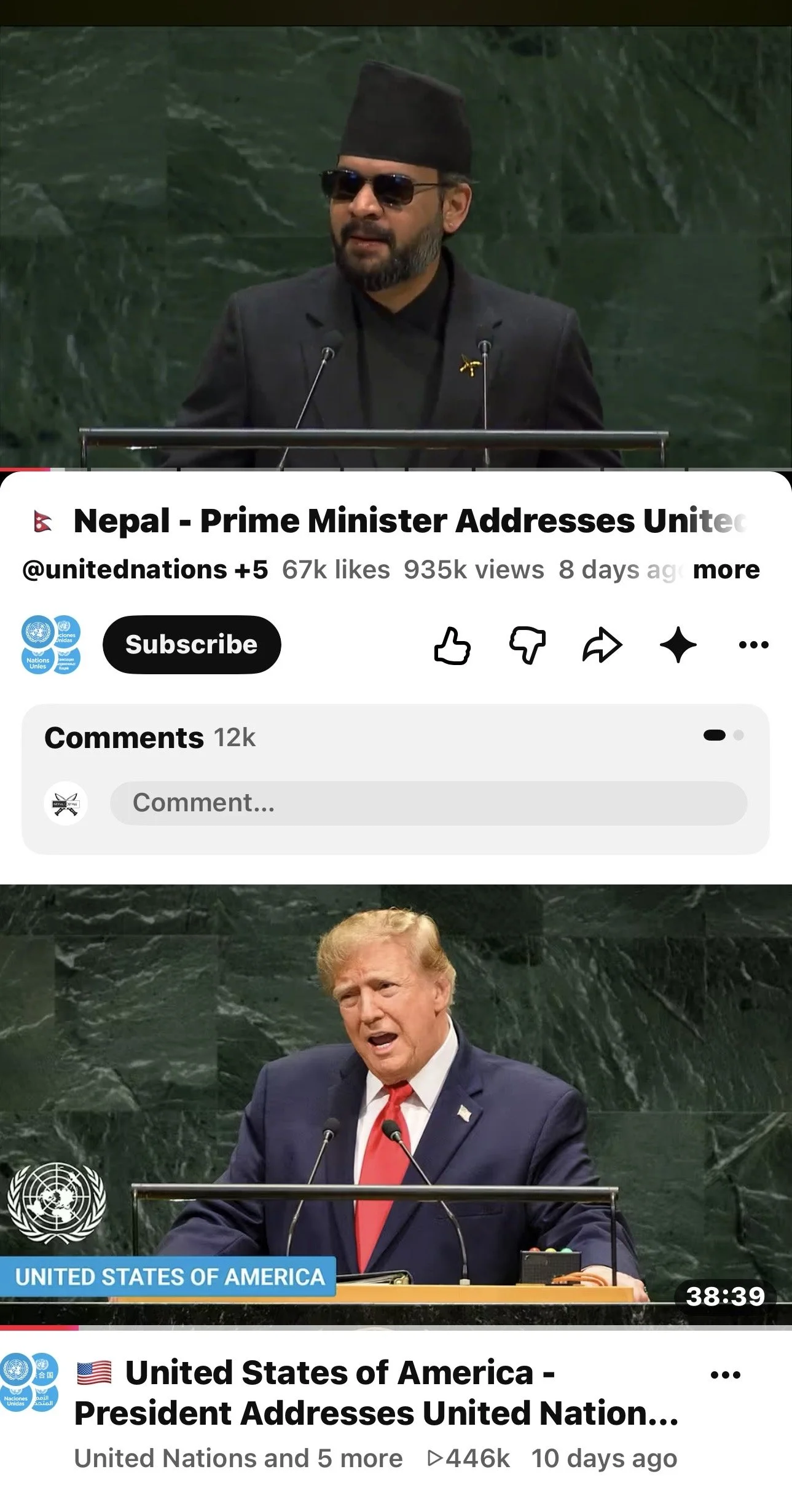
The United Nations General Assembly stage has seen its fair share of historic moments, fiery declarations, and geopolitical posturing. But every once in a while, a leader steps up to the podium not to play the traditional diplomatic game, but to deliver a blunt reality check that stops the global room in its tracks.
That is precisely what happened when Nepal’s Prime Minister, Balendra (Balen) Shah, took the floor at the 81st Session of the UNGA. Eschewing polite diplomatic throat-clearing, the young leader opened with raw truth—addressing the devastating flash floods that recently tore through the Himalayas, wiping out communities and leaving families searching riverbanks for loved ones who will never come home.
The Full Viral Speech: Prime Minister Balen Shah at the 81st UNGA
"Mr. President, Mr. Secretary General, Excellencies, Distinguished Delegates, Ladies and Gentlemen,
I come before you from Nepal, a distant country in the Himalayas, carrying a close warning for humanity. I wish I could stand here today simply to speak about development, democracy, peace, and the hopes of a young nation. Instead, I must speak about death and destruction of epic proportions.
Our mountain slopes are becoming unstable. Our rivers are becoming less predictable. Last month, we saw the tragic consequences. Its devastating impact was seen on both sides of the Nepal-China border, and the flood reached India downstream. This teaches us one fundamental thing: Climate change knows no borders. Glaciers and floods do not carry passports and visas.
Nepal contributes less than 0.1 percent of the world’s total greenhouse gas emissions. We did not cause this crisis, yet we are paying a heavy price for it. For Nepal, climate catastrophe is not just a humanitarian event, but a development emergency. It destroys roads, bridges, schools, homes, farms, and livelihoods. And it forces a poor country to borrow money to repair damage it did not cause.
But we have not come here to blame any country or continent. We are here to ask everyone to recommit, to share responsibility and solidarity. As an urgent first step, we propose that we establish a Himalayan Climate Resilience Mechanism, led by Nepal, India, and China. Through this mechanism, let us share satellite data and expertise, monitor dangerous glacial lakes, strengthen joint early-warning systems, and coordinate assistance across borders. Let the Himalayas become a laboratory of international cooperation rather than a frontier of fragmented information.
Climate finance must not become a bureaucratic maze through which vulnerable countries spend years proving that they need help. When a house is burning, we don't make the family fill out 50 forms; we take action. This is what climate justice should mean.
Today, the international system is under strain. Too often, military and economic power determines whose voice is heard. Inter-continental missiles arrive on time. Rifles and ammunition cross borders, clear every bottleneck, meet each deadline. But a peasant in Nepal cannot procure his fertilizer or fuel at market price at a time of need. We have built a world with flawless logistics for war and broken logistics for food.
This is why we continue to believe in multilateralism, and why we need a United Nations in which the presence of small, poor countries is felt. Climate justice is not just about money. It is about distributive justice—who bears the cost? It is about procedural justice—who has a voice?
The Nepal floods signal a future shaped by rising climate extremes. Our baselines are no longer relevant, and we must move from ad-hoc responses to a culture of preparedness. Let us finance resilience, build stronger infrastructure, reduce fossil-fuel dependence, and reform the order that leaves the weakest with the least power.
And when the next warning comes from the rooftop of the world: Let us be ready to hear it, and ready to act.
May Lord Pashupatinath bring about the welfare of the world. May this world walk on the path shown by the Buddha.
Thank you very much. Namaste."
The Trump Scenario: Outpacing Washington on the Digital Stage
While the powerful policy lines and his demand for the six foundational "R's" (Relief, Rehabilitation, Reconstruction, Responsibility, Reparation, and Resilience) resonated deeply within the assembly hall, it was the aftermath outside the hall that shocked international media analysts.
In an unexpected digital twist, when the United Nations uploaded the official video archive of speeches to YouTube, the viewing metrics told a striking story. Prime Minister Balen’s address rapidly accumulated massive global engagement, out-pacing the view counts and algorithmic traction of heavy-hitting political figures like Donald Trump’s speeches from the exact same assembly period.
For a leader from a landlocked, developing Himalayan nation to capture a larger digital audience than Washington’s political giants highlighted a shifting global tide: the world is growing tired of repetitive geopolitical theater and is urgently gravitating toward raw, ground-level truths about survival and systemic global reform.
